

February 2016. Ten years ago, I was at a crossroads.
I was in my last year at UC Irvine as a psychology major. I wanted to do something related to helping people find meaning at work. There were two questions living rent free in my brain:
Should I continue my academic path and get a PhD in Industrial-Organizational Psychology?
Or… should I try to break into organizational design?
I had no idea 2) was even an option until I started using Twitter. I learned about companies like August, NOBL, and The Ready… and there was an explosion of essays like these. Essays like inspired me to start writing too. So I started writing.
A Twitter buddy of mine, Sam Spurlin, offered me a freelance writing gig at The Ready. I wrote my first essay for The Ready. It did well. Aaron, The Ready’s founder and Responsive org founding member, was stoked about it.

Around this time, I get an email from Robin Zander about a Future of Work “un-conference” in SF. I drove from Irvine to SF just to attend.

It was unlike any conference I’d been to.
We drove the agenda!?
Everyone got to talk and participate and build relationships?
I get to… share my thoughts?!
I was so used to academic symposiums, where you’re being talked at for an hour about some research. This Future of Work Un-conference broadened my aperture and connected me with other cool individuals doing something related to improving work.
A month later, I get a full-time offer to work at The Ready as a consultant. I pack my bags, move to NY, and start my career in org design.
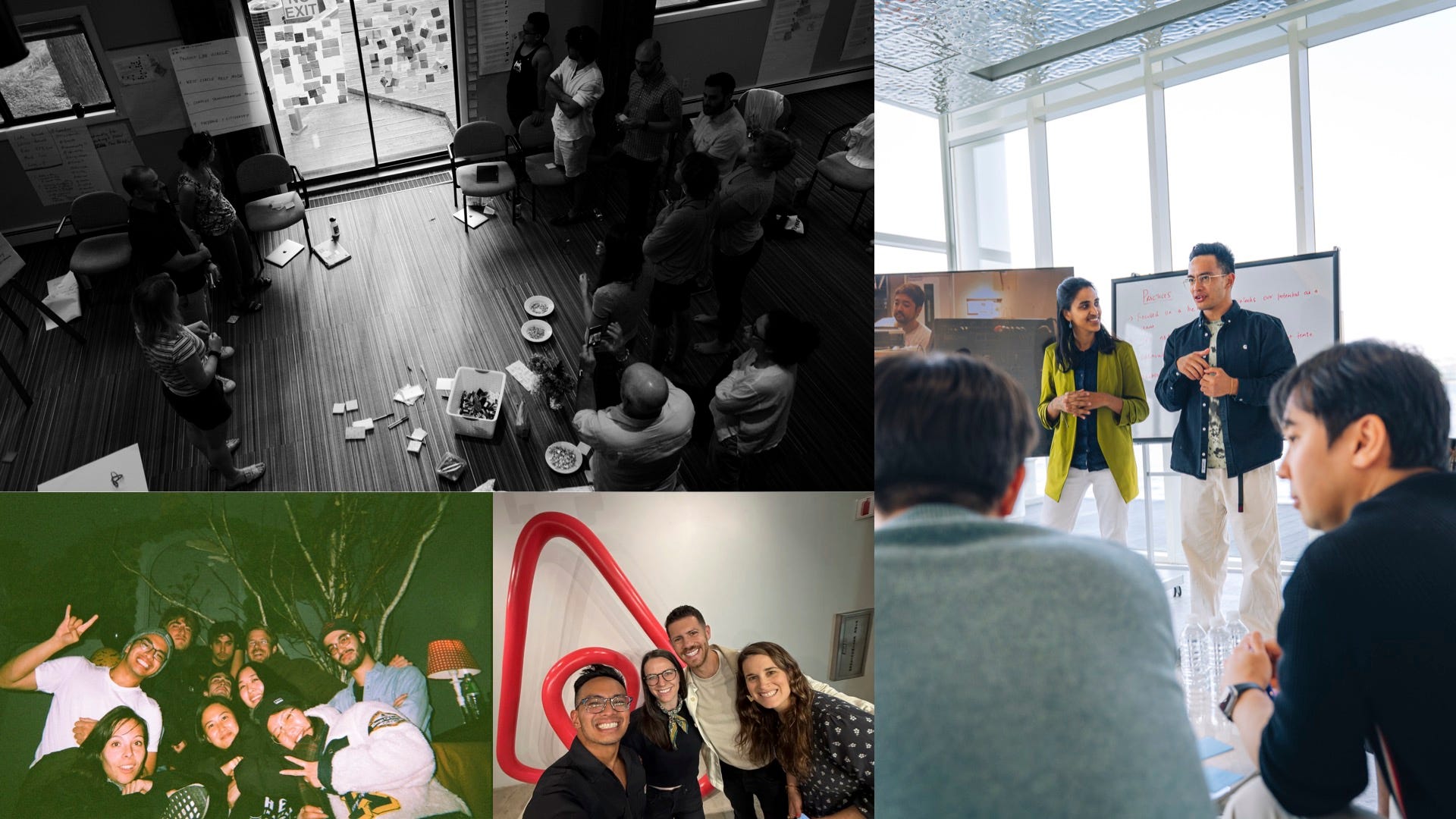
🏖️✈️🗽✈️🏔️
Ten years later.
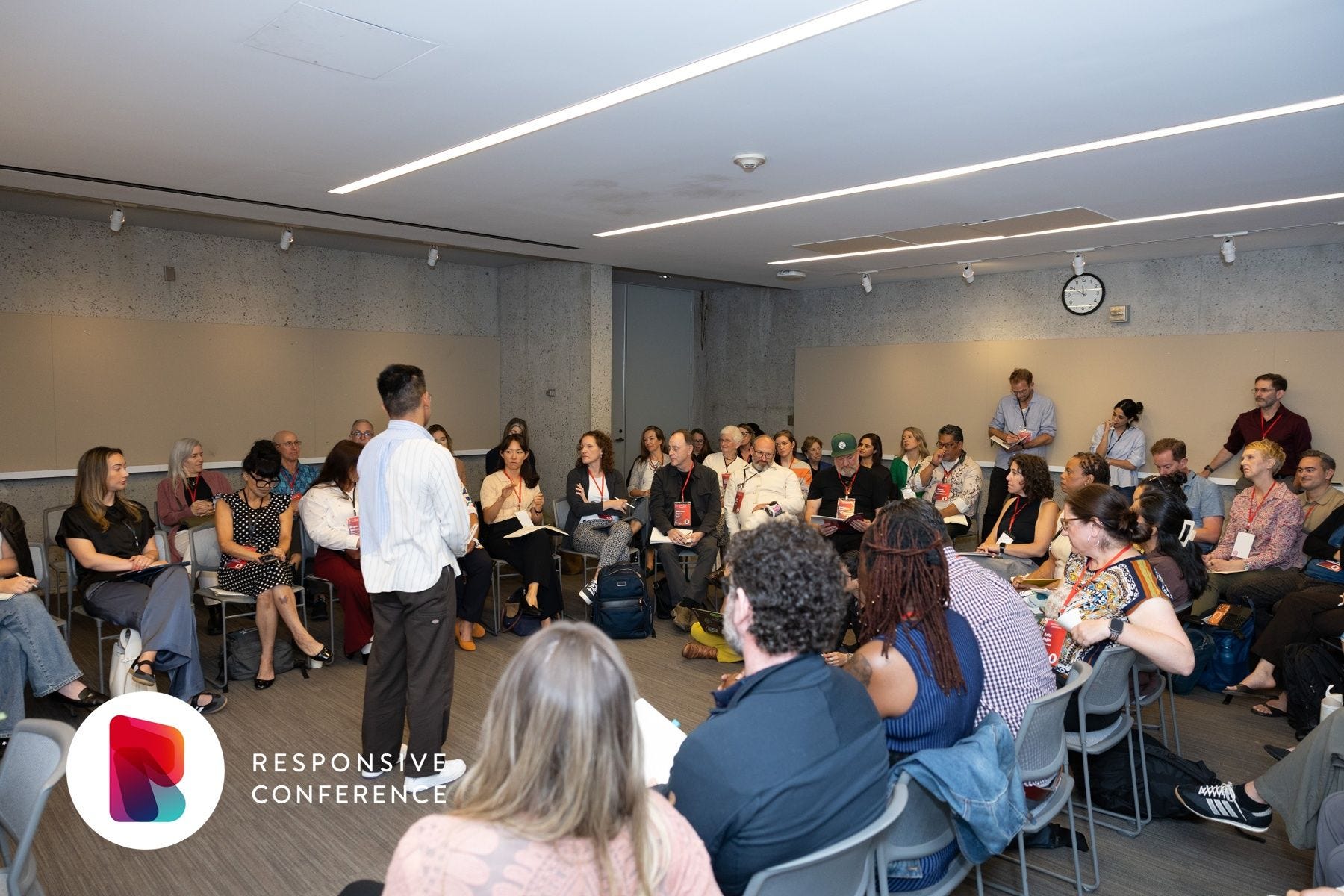
Two weeks ago, I gave a talk at Responsive Conference in Oakland.
Speaking here a decade later felt very full circle. Thank you Robin and the whole Responsive crew. 🙏🏽
My talk was called How Not to Change Your Organization. Here’s the written version. Full deck is here.
If you’d love for me to speak with your team/org, email me at timcasasola@gmail.com.

You’ve gotten this email before.
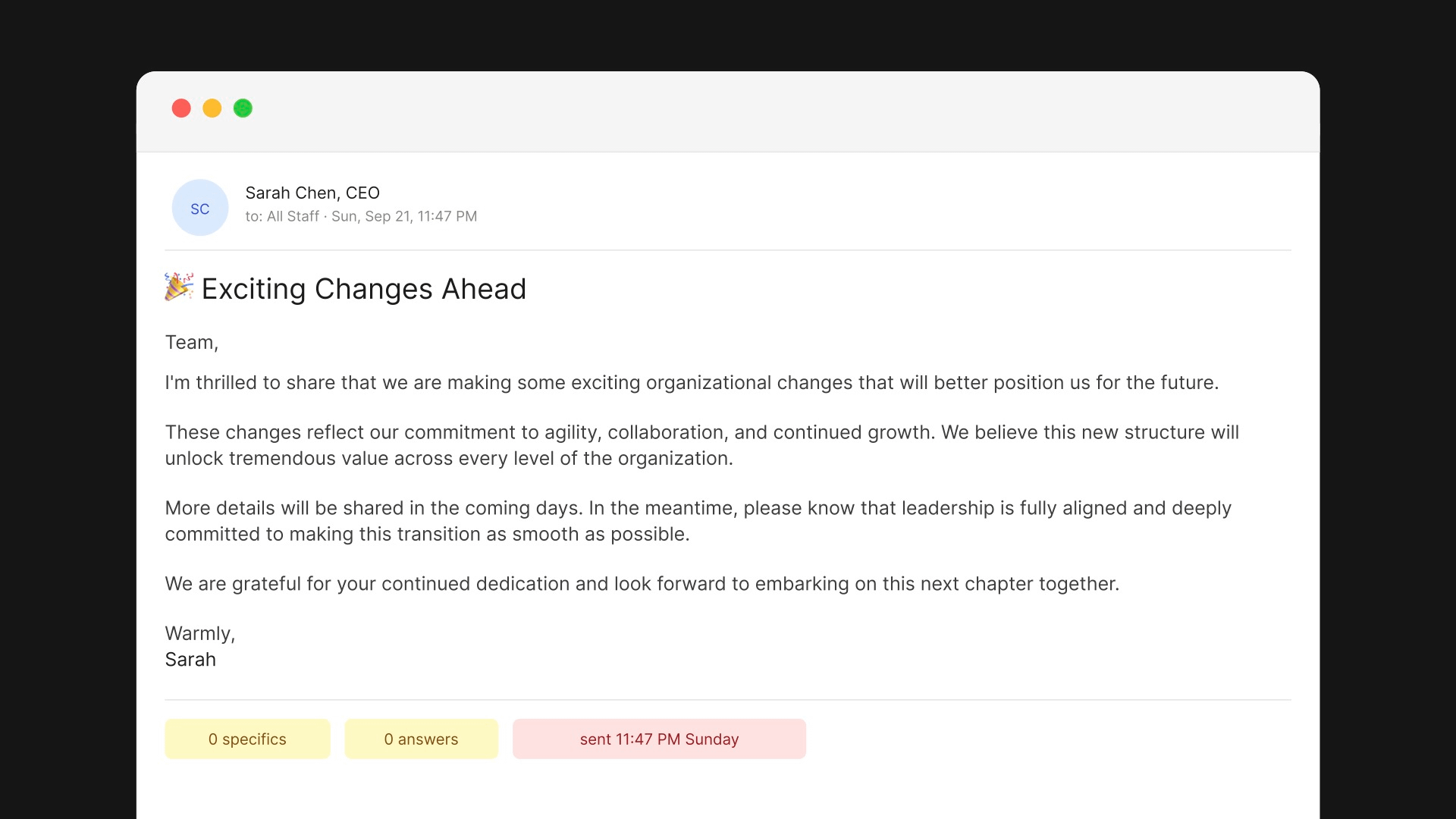
“We are making some exciting organizational changes that will better position us for the future…” Zero specifics. Zero answers. Sent at 11:47pm on a Sunday.
“How many of you have gotten an email like this in the past two years?” Almost every hand went up.
“How many of you knew what it actually meant?” A few hands dropped.
“How many of you have had to send this email?” Some hands went back up.
This talk isn’t about the reorg itself. It’s about the mistakes we make after that email gets sent.
I’ve made all five of these mistakes.
Five ways to mess up your org change
1. Believe hierarchy is the structure
We all know the org chart. Who reports to whom.
But… do we really know the org chart? The official one doesn’t tell you who actually calls the shots. Who owes who a favor. Who has an old score to settle.
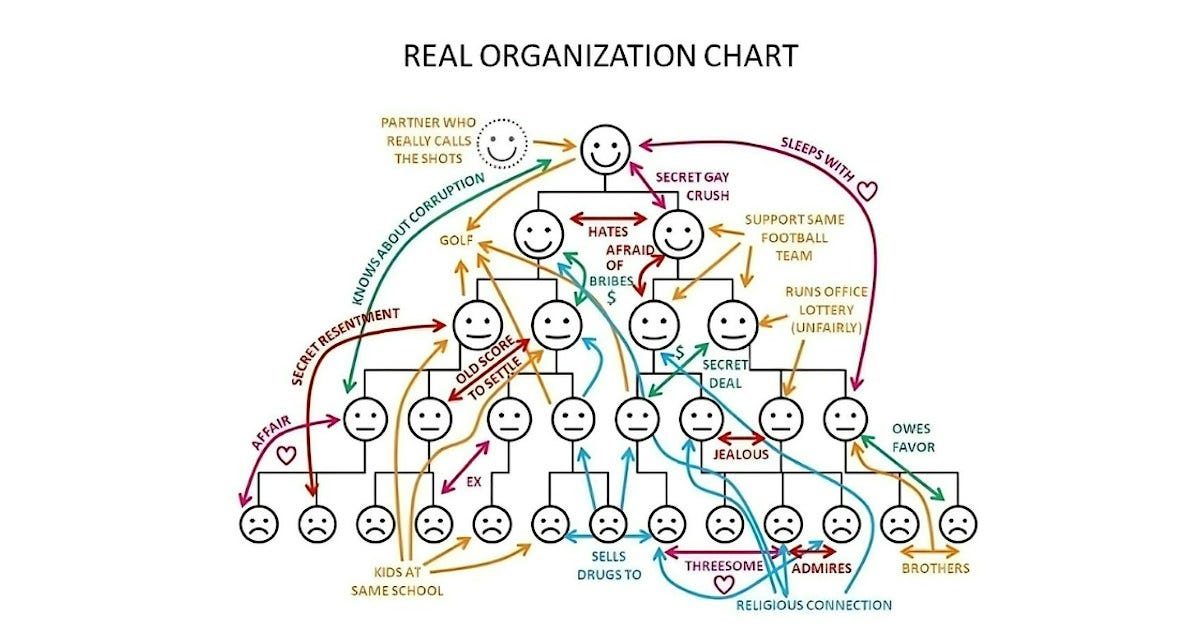
Whenever I start with a new client or a new job, I map my understanding of the organization in my notebook. One node and one relationship at a time. And every time, a few weeks in, my map looks nothing like the org chart. Budget flows through people who technically don’t own it. Someone who reports to one leader actually works for another.
The org chart says one thing. The actual decision-making says another.
Niels Pflaeging describes three structures in every organization:
Formal: the org chart.
Informal: who actually talks to who. Who trusts who. Who owes who a favor.
Value creation: where the work actually happens. Where value flows.
Most change efforts only redraw the first one. I wrote about this back in 2020 in Reimagine the Org Chart.
So instead of believing hierarchy is the structure, draw your own map.
2. Keep information secret
A story. My coworker and I were once facilitating a strategy offsite for a client team. When we dropped our slides into their master deck, we saw a slide that said:
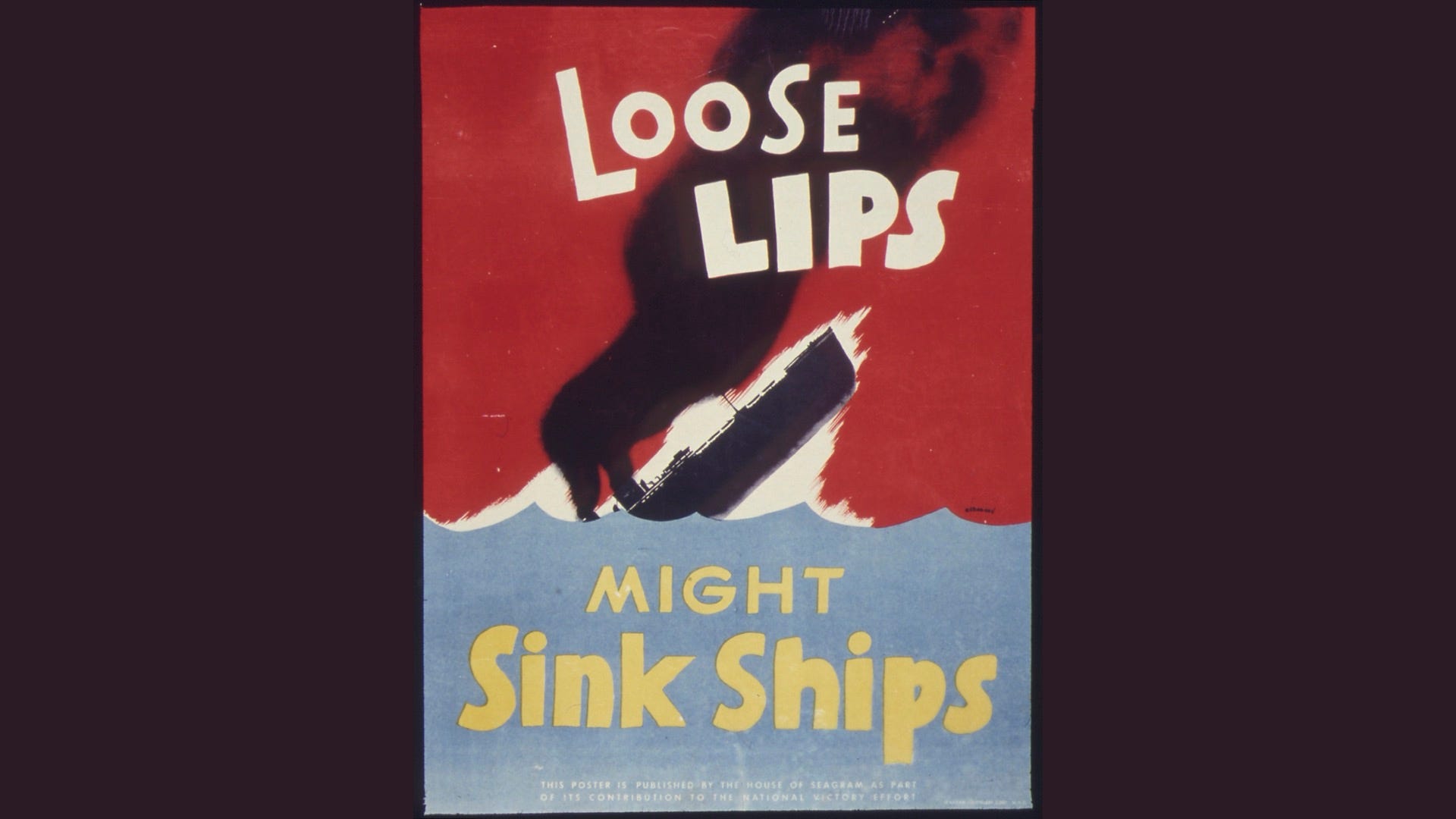
Our jaws dropped. The offsite was about their strategy, information that would actually help other teams. But secrecy was the default.
I come from the school of defaulting to open. Unless there’s a good reason to withhold it, share it. There’s more upside in sharing information than in hoarding it. I practiced this at The Ready, and it’s why I pushed for transparent salaries at garden3D (benefits and jitters included). Even the Responsive Org manifesto says the benefits of sharing information often outweigh the downsides.
Margaret Wheatley writes that “information chastity belts are a central management function.” I’m still laughing at that banger of a line. I wrote more about this in Information as salmon.
On my team at Airbnb, we’d tag Slack messages with a “cascade” emoji whenever we learned something the rest of the team needed to know. Small. But it kept the streams clear.
So instead of keeping information secret, default to transparency.
3. Solve the problem before you see it
At one organization I worked with, everyone was encouraged to learn Claude Code. So cool! Anyone can make a prototype! I had a lot of fun with it.
But… we were throwing HTML files left and right. Lots of meetings still felt unclear about what we were solving for, despite having tons of pixel-perfect solutions.
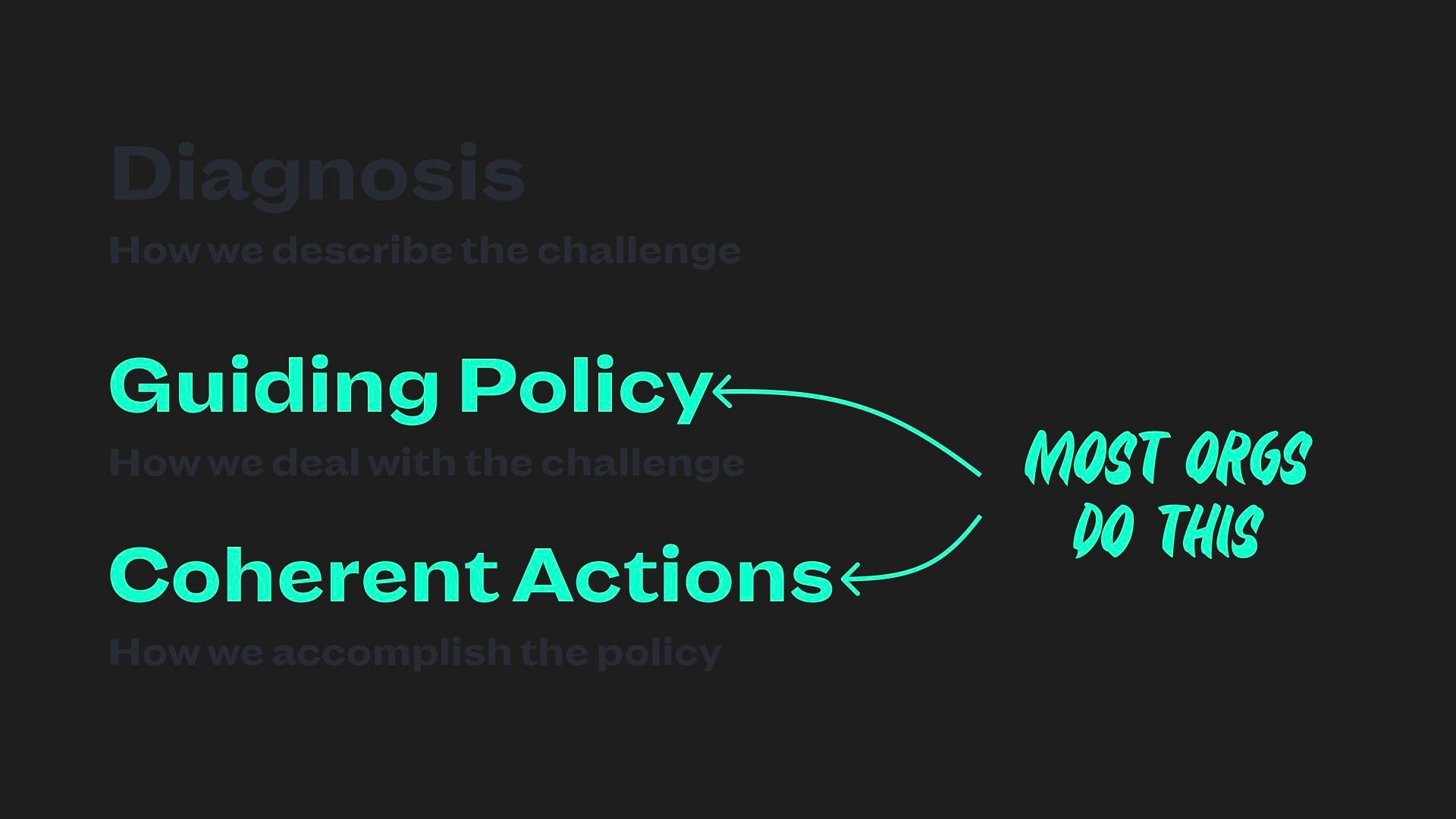
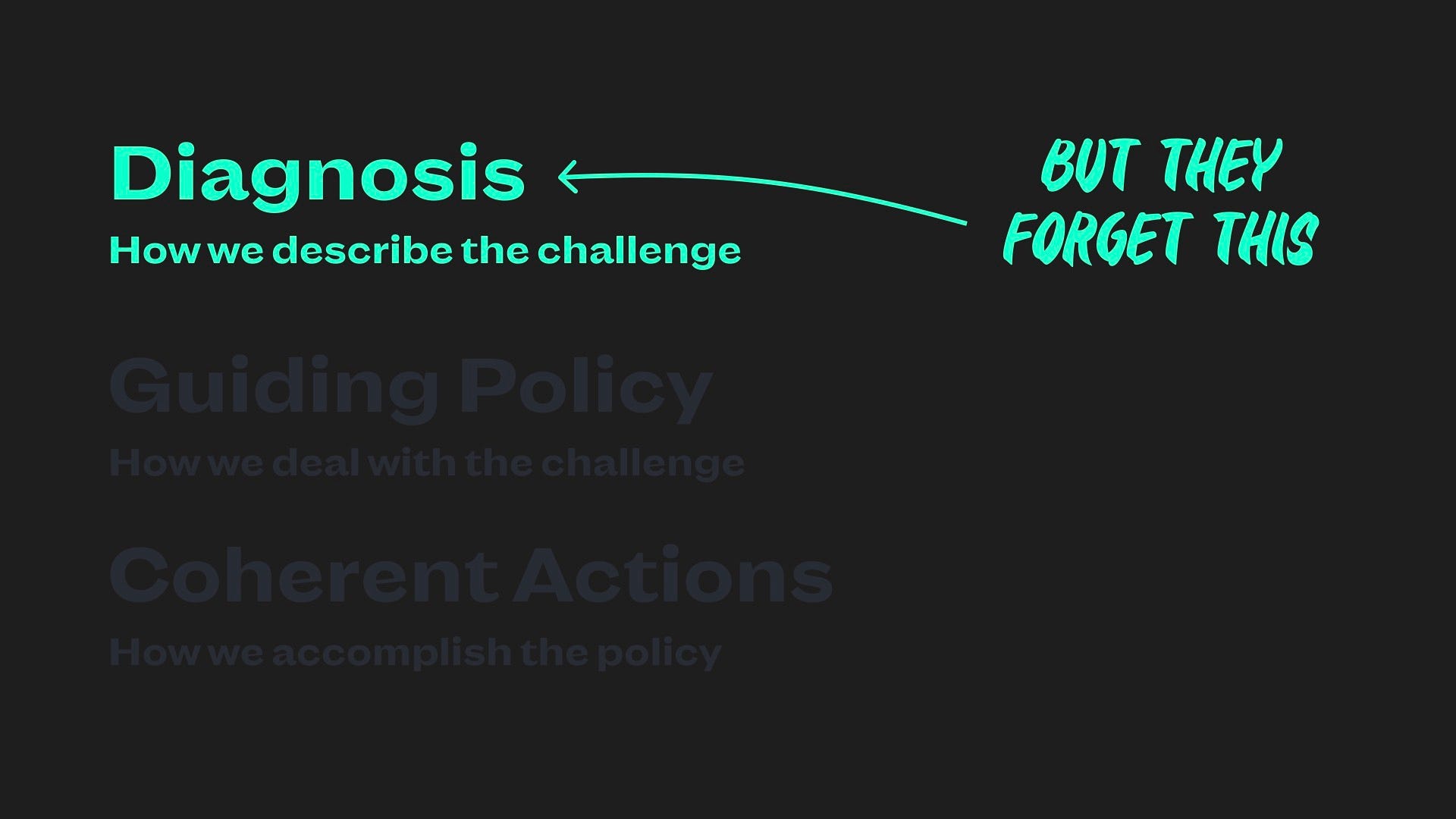
Richard Rumelt says good strategy has three parts:
A diagnosis
A guiding policy
Coherent actions
If you’ve read Strategy as a sweet spot, you know that most orgs focus on the guiding policy and coherent actions parts, but skip the diagnosis. Most orgs have a strategy that doesn’t solve the main problem.
What I’ve learned now is that AI is very good at steps two and three. It is the master solutioner. But it can pull us away from the why.
Something John Cutler wrote that sticks with me is diagnose before you automate. That’s literally my new mantra. (More on this in please make me think.)
So instead of solving the problem before you see it, diagnose before you automate.
4. Prove your value
I’ve worked in two kinds of cultures. I’m sure you have too.
Performance culture: Taking credit. Talking over people. Caring about whether the director sees you.
Learning culture: Inviting other perspectives. Actually talking to people outside your team. Taking time to reflect. Celebrating failure. Lifting others up. Not being afraid of hard data.
I’ve been guilty of performing in a learning culture.
There was a retro at The Ready that I’ll never forget where our most senior partner called many of us out:
“I see a lot of proving one’s value here. This is getting in our own way. By being here, you’ve already proved your value.”
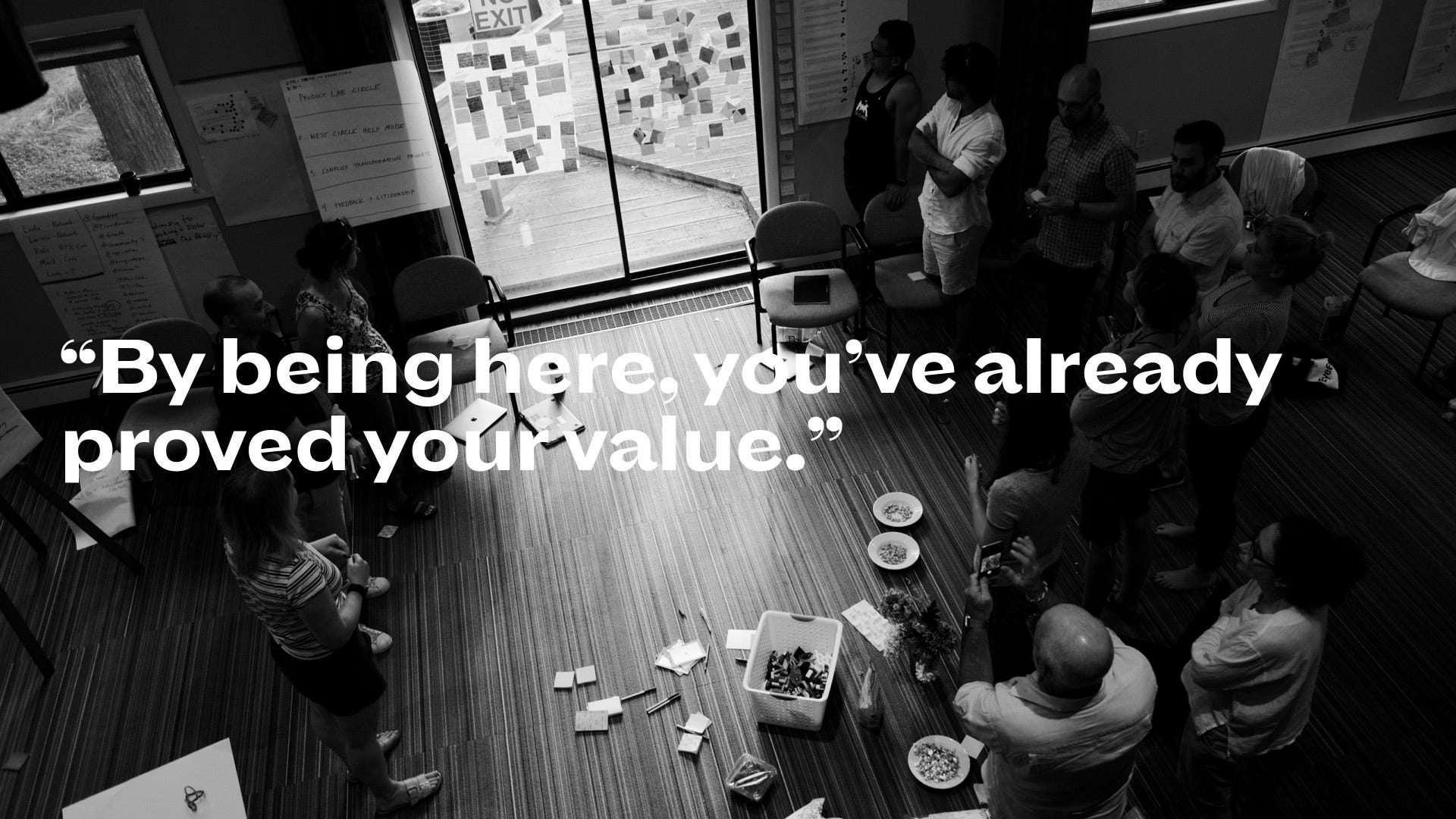
It’s stuck with me ever since. In 2021 I wrote don’t prove value, create it. My longing to be seen as valuable made my work less valuable. The less I tried to prove myself, the more value I actually created.
So instead of proving value, create it.
5. Forget that you’re part of the system
As change agents, we’re quick to criticize an organization’s dysfunction. We see the shit.
But we often miss our own role in the shit. Blame it on the self-serving bias: when things go well, we take credit. When they don’t, we blame the system.
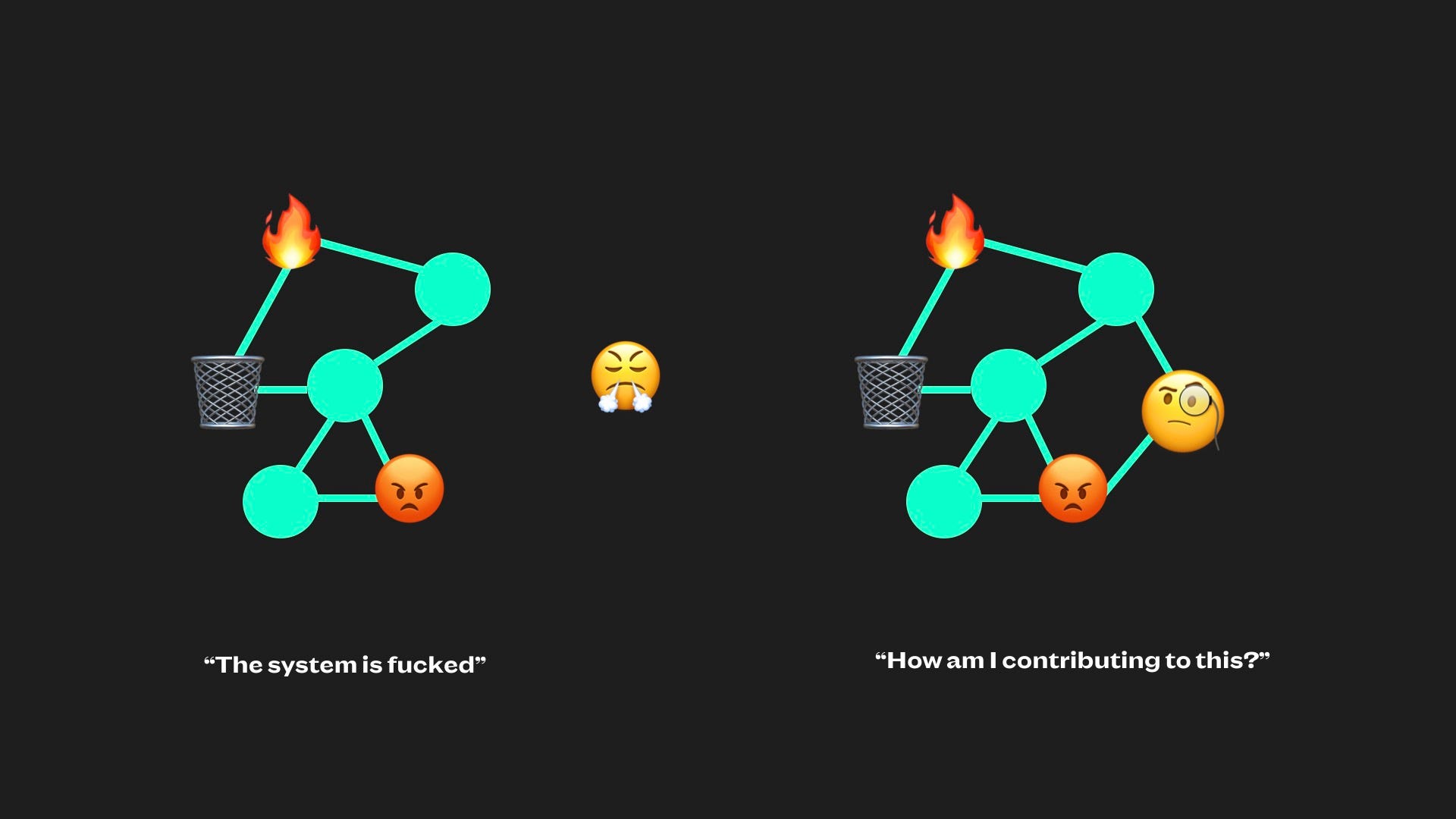
So here’s a question I try to ask myself: how am I contributing to the very dysfunction I want to change?
We are all complicit in the conditions we want to change. In life, and especially in work. And when we change, others change too.
So instead of seeing yourself outside of the dysfunction, own your part.
We are interventionists
In 2016, Fast Company named “Interventionist” one of the most important design jobs of the future.
Ten years later, it still describes what we do better than I ever could. We understand complex systems and intervene.
So the next time you get that email (or have to send it):
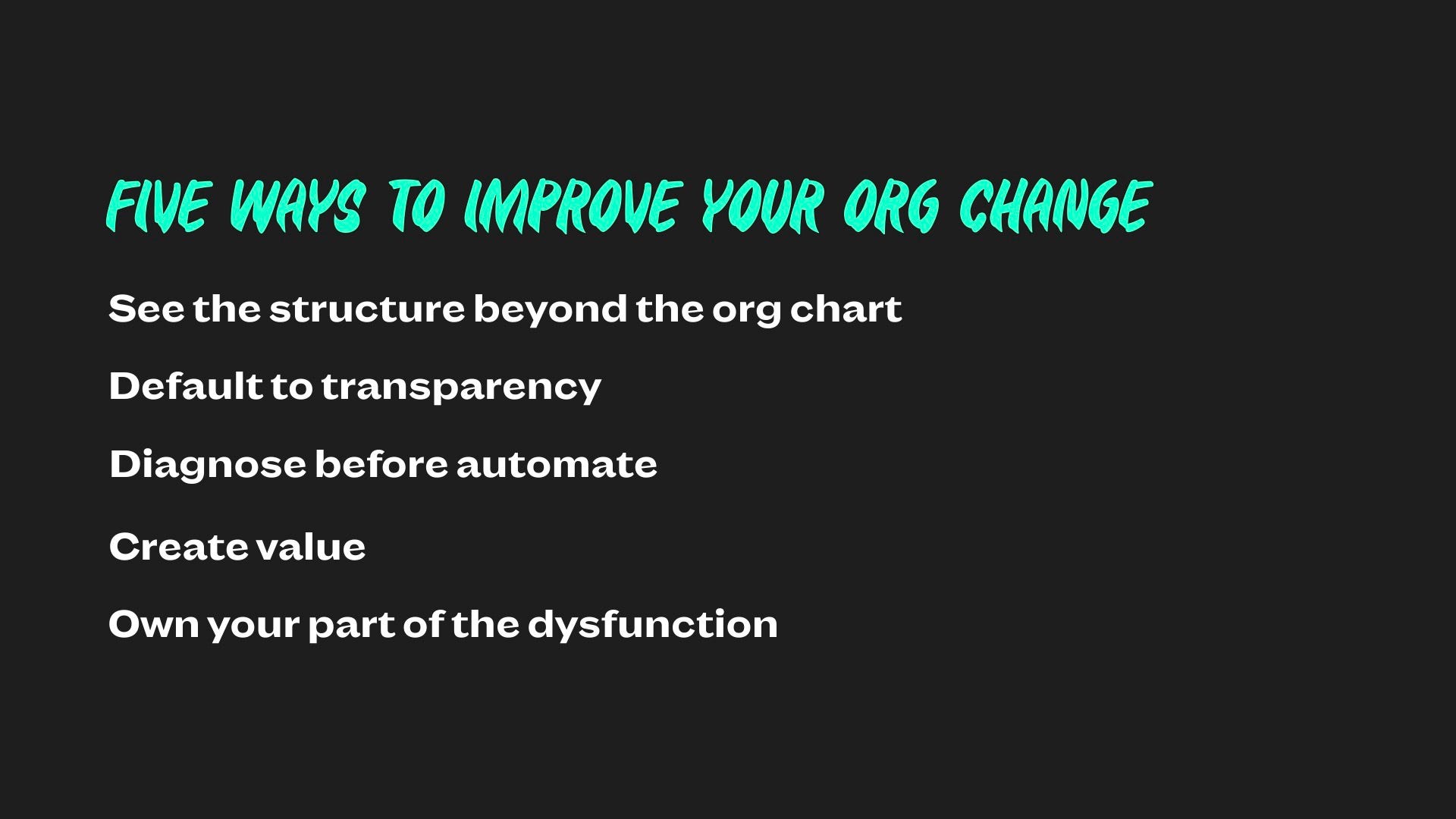
See the structure beyond the org chart
Default to transparency
Diagnose before automate
Create value
Own your part of the dysfunction
Thank you!
Thank you to Robin and the Responsive team for the conference and photos! And to everyone who came up afterward to chat.
Slides here.
Special thank you to Matt LeMay for helping me make this talk super focused. Matt is a veteran speaker and writer and my talk would’ve been more all over the place if it weren’t for his feedback.
If you’d love for me to give a version of this talk to your team, email me at timcasasola@gmail.com.
–tim
Wow
hell yeah.